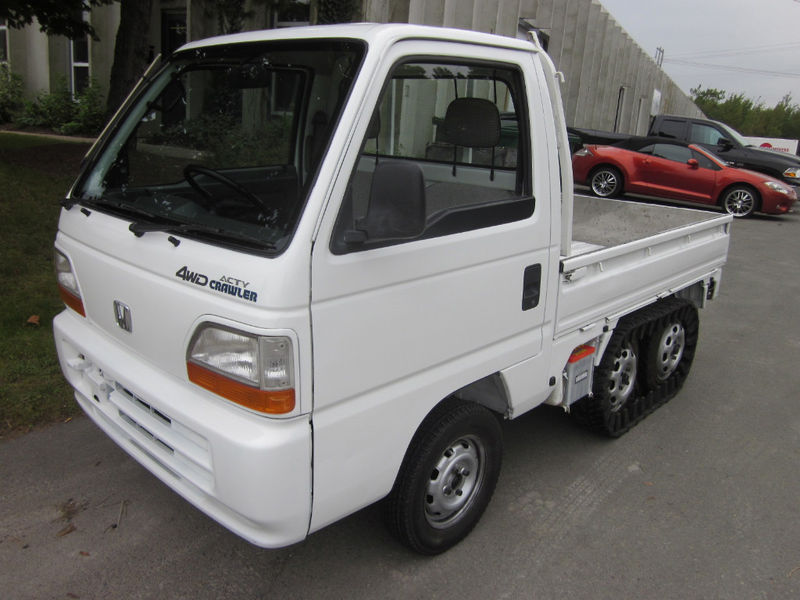
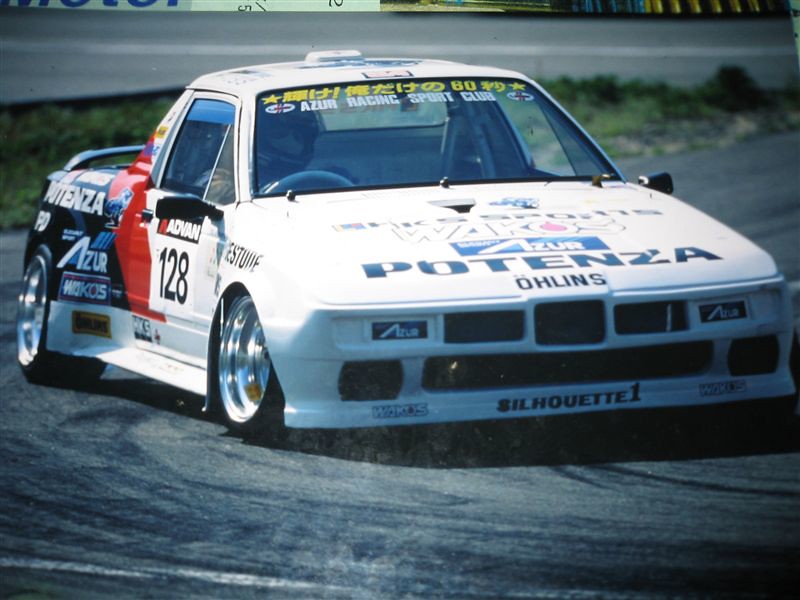
The Suzuki Mighty Boy is a Kei-sized pick-up version of the second generation Suzuki Cervo two-door fastback coupé released in February 1983. It was classified as a commercial vehicle in Japan (and in Australia) so as to benefit from lower taxes for such vehicles, but its utilitarian values were certainly limited.

Its lineage goes back as far as Suzuki has been building cars. The original Suzulight (1955-57) was the company's first attempt at car manufacture; only 43 of these vehicles were built during the two years of manufacture. Full production began in 1962 with the 2-cyl, 2-stroke, air-cooled, fwd Suzulight 360. A number of different versions were released including 2 & 3 door saloons, an estate and a pick-up - the Suzulight SP.The LC10 Fronte 360 2-door was introduced in March 1967 to replace the earlier Suzulight Fronte. The Fronte 360 was more up to date than the Suzulights with a lightweight, 3-cylinder engine. There was even an 'SS' version, producing 36hp at 7000rpm. It was updated in 1970, with a 500cc export version being introduced.


April 1976 saw the Kei laws change, allowing more engine displacement (550cc) and slightly larger dimensions (3.2metres length by 1.4 metres width. The Mighty Boy probably owes part of its existence to these changes. At the time, the manufacturers jumped at the opportunity to upgrade their vehicle ranges, Suzuki introducing a new series of Frontes, including a coupe version called the Cervo, in 1977. This rear-engine 539cc fastback is a popular classic car in Japan and its slowly earning classic status here in the UK too, as its alter ego the SC100 Whizzkid. The next event that leads to the introduction of the Mighty Boy was an overhaul of the Fronte range in 1979.
 |
| Norman Rockwell. The obvious way to advertise a Japanese pick-up. |
The 4th generation switched from rear to front-engined, transverse 4-stroke engines and commercial versions were renamed the Alto, the name also used for export. It was a technical revolution (for Suzuki at least) that paved the way for future cars like the Cervo range, the Swift - and the Mighty Boy, which is the '82 Cervo except with a load bed instead of a glass liftback . The floor pan, engine and running gear. are the same - however, from 1983 onwards, the Cervo was released with a turbocharged 543cc SOHC three-pot F5A lump (Cervo De Tomaso) which gave it 40hp at 6000rpm; some Cervos may have been released with a factory-fitted supercharger. However, unlike its ‘civilian’ cousin, no turbo was available for the Mighty Boy.
 |
| The Cervo Coupe, the base for the Mighty Boy, seen here in Turbo guise |
Driving the front wheels through a 4-speed manual or optional 2-speed automatic gearbox, the F5A motor delivered 27bhp at 6,000 rpm (22.7 kW/30.9 PS and 31.8 lb/ft of torque at 3,500 rpm
First generation Mighty Boys were fitted with dinky 10" wheels, and sported a horizontally finned grille, identical to the Cervo. While the Cervo used rectangular headlights, the Mighty Boy, as befitting the cheapest car available in Japan, had cost-cutting round sealed beam units. A feature unique to the Mighty Boy was the seats, which although still similar to those featured in the Cervo CS/G, featured a customised embossed "Mighty Boy" logo. Second generation Mighty Boys received minor cosmetic upgrades, including a restyled front grille and mirrors. In addition, the range was extended to two variants: the base PS-A model carried over the 10" wheels from the 1st gen Mighty Boy and was available with a 4-speed gearbox only, while the PS-L and PS-QL models came equipped with sports seats, larger 12" wheels, chrome roof rails, and a rev counter. In contrast to the base model, a choice of 2-speed automatic or 5-speed manual gearbox was offered, and rectangular headlights were fitted.

The Mighty Boy was in production from 1983 to 1988 and for the most part was alas, a Japan-only model, with two exceptions The only export markets for the MB were Australia and Cyprus between 1985-1988. Imported through Suzuki/Ateco, Australia received a hybrid of the Japanese PS-A and PS/QL second generation Mighty Boy that included chrome roof rails, sports seats and 12" wheels, however did not include such items as a rev counter or 5-speed manual gearbox. The manual version sold for AU$5795 when introduced to Australia, the cheapest car available there at the time. About 2,800 were imported, but only 300 - 400 now exist.
 |
| All-black with De Tomaso bits. Mmm. |
 |
| Blue and white with wing splitters. Hmmm. |
The rationale for the production of such a quirky vehicle is in doubt. Perhaps there was a legitimate need for a small commercial courier vehicle on the busy streets of Tokyo, but then surely the likes of Suzuki’s own Carry (which we got in the UK as the Bedford Rascal) fulfilled that role. At any rate, the Mighty Boy enjoyed a short popular run as a 'lifestyle' car in Japan and Australia As far as commercial applications go, there were reports of fleets of Mighty Boys operating as pizza delivery trucks, the tray-floor being roughly equivalent in area to two family-size pizzas, with plenty of room behind the seats for a bottle of Coke and a couple of garlic-breads.
 |
| For work... |
 |
| For play... |
 |
| For the moon... |
Even though they were considered to be a bit of a joke when first seen in Australia, the Mighty Boy gained credibility fairly quickly and there were stories of convoys of them heading north along the east coast - towing special little surfboard trailers. Its one-off singularity combined with its nonsensical name seems to have gained it some level of recognition and inner-city street-cred in Oz; given the budget, we’d import one and stick the DeTomaso’s turbo’d engine in – no chance of that pizza going cold.
With thanks to all concerned for the raw info